
Thrain Stonefist
Contents
Overview
Thrain Stonefist, later known as Ember Stonefist, was an early follower of Ignius and is traditionally regarded as the first formal initiate of The Scorched Hand during the age of The Void. Initially celebrated as a martyr-like figure of unwavering devotion, later historical traditions portray Stonefist as one of the central causes of The Scorching and the eventual fall of Pelor’s Homeland. Stonefist remains one of the most divisive figures in Scorcian religious history. To orthodox followers of the Scorched Hand, he is remembered as The First Betrayer. Revisionist historians and anti-Pelorite sects, however, sometimes describe him as a tragic figure consumed by forces beyond his understanding.
Early Life
Before his exile to the Void, Thrain Stonefist was reportedly a blacksmith from an unknown dwarven settlement. Several surviving accounts claim he refused to forge weapons for a tyrannical warlord and was subsequently condemned to Solmourne. Descriptions from early records portray him as: “broad as an anvil, half-starved, one eye gone, yet still carrying himself like a man who remembered honest work.” Stonefist’s appearance became iconic in later Scorched Hand imagery. He was described as a heavily-built Dwarf with a tangled beard, mismatched scavenged armour, and a crude leather eyepatch. Numerous accounts also mention his habit of rhythmically tapping his fingers against nearby surfaces, supposedly developed to maintain his sanity within the Void. According to the Nux Diary, Stonefist possessed a contradictory temperament: “He looked like the sort who’d cave your skull in for looking wrong at him, but he’d give half his food to anyone shivering harder than him.”
Meeting Ignius
Stonefist first encountered Ignius during the famine years preceding the Thawing. At the time, Ignius was still considered a strange but increasingly influential preacher operating within the old Prisoners’ Encampment. The relationship between the two figures appears to have been unusually close during the early years of Pelor’s Homeland. Where Ignius was charismatic, articulate, and zealous, Stonefist embodied physical endurance and visible sacrifice. Historians often describe Stonefist as the “proof” that Ignius’s teachings could transform broken individuals into devoted followers. Some later Scorched Hand writings portray the relationship in near-mythic terms: “Where the Emblazoned One spoke, Stonefist stood.” Nux’s writings, however, suggest something more human and complicated. Several entries imply that Ignius genuinely trusted Stonefist in ways he trusted few others.
The Mountain Pilgrimage
Stonefist’s rise within the early Scorched Hand is closely associated with the first pilgrimage to the mountain temple that would later become the House of Pelor. During the expedition, the party and accompanying followers were ambushed by skeletal archers concealed beneath the snow. While many civilians fled or took cover, Stonefist reportedly held the line beside Ignius and several adventurers. Contemporary accounts suggest Stonefist was mortally wounded during the fighting and only survived due to magical intervention from his companions. Following the battle, Ignius formally granted him the title Ember Stonefist, making him the first known follower elevated into the Scorched Hand hierarchy. Orthodox tradition interprets Stonefist’s survival as evidence of divine favour. Stonefist himself reportedly became convinced that Pelor had personally spared his life. The Nux Diary records the aftermath more cautiously: “Thrain looked at Ember [Ignius] like a drowning man looks at shore.”
The Haunting
The turning point in Stonefist’s life is widely believed to have occurred during an expedition to the haunted mansion later associated with Willow La Bête. During the expedition, a shadowy figure reportedly offered several members of the group an opportunity to draw enchanted cards as part of an unknown game or trial. Stonefist accepted. Accounts differ regarding what Stonefist witnessed upon revealing the card. Some traditions claim he saw his own death. Others suggest he witnessed a realm of darkness beyond Solmourne itself. Several Scorched Hand inquisitorial texts later claimed he “looked upon the false sun.” Whatever occurred, surviving witnesses unanimously describe Stonefist as deeply changed afterward. According to Nux: “He laughed less after the Mansion. Even his tapping changed. Slower. Like counting.” Later reports describe increasing paranoia, long unexplained disappearances, and strange conversations held alone in darkness.
Hidden Faith
Over the following centuries, Stonefist rose steadily within the hierarchy of Pelor’s Homeland. Most traditions agree he eventually became one of the highest-ranking figures beneath Ignius himself. However, later investigations conducted after The Scorching alleged that Stonefist had secretly become devoted to another deity or cosmic force entirely. The identity of this entity remains debated. The most common theory links Stonefist to a death-associated figure resembling Anubis. Other theories instead connect him to shadow entities associated with Noctyra. Several surviving testimonies suggest Stonefist subtly redirected sections of the Scorched Hand away from Pelorite doctrine while maintaining outward loyalty to Ignius. This process reportedly took generations. Modern historians often compare the movement to a gradual theological infection rather than an outright schism. One recovered inquisitorial fragment states: “The prayers remained the same, but the meaning behind them changed.”
Relationship with Ignius
The relationship between Stonefist and Ignius has become the subject of extensive theological and historical debate. Early records suggest genuine friendship and loyalty between the two men. Ignius trusted Stonefist enough to elevate him publicly during the formative years of Pelor’s Homeland. Some historians argue that Stonefist represented the ideal follower in Ignius’s eyes: hardened by suffering, utterly devoted, and willing to sacrifice himself for faith. Others suggest Ignius became emotionally dependent upon Stonefist’s loyalty. In this interpretation, Stonefist’s eventual betrayal was not merely political or theological but deeply personal. A controversial school of modern historians argues that Stonefist may initially have attempted to resist the influence corrupting him. Supporters of this theory often cite:
His increasingly isolated behaviour
Reports of self-destructive tendencies
Accounts describing him warning followers away from certain rituals
References to his obsessive finger-tapping “counting” patterns
These scholars propose Stonefist may have believed someone was attempting to assassinate him because he understood he was already compromised.
The Scorching
Stonefist’s ultimate fate remains uncertain. The dominant Scorched Hand narrative claims that when Ignius returned from his search for the Shadow Realm, he discovered Pelor’s Homeland corrupted from within by Stonefist’s hidden influence. In response, Ignius caused the eruption of Pyraxis, cleansing the world in holy fire. No surviving source definitively records Stonefist’s death, however several reputable sources suggest that Stonefist was still alive during this period, or at least Ignius actively spoke about Stonefist’s betrayal as if he were still alive. Several conflicting traditions exist:
Death during Pilgrimage: During the early years of the expansion of Pelor’s Homeland and the establishment of a number of other communities within Solmourne, several pilgrimages seeking religious influence came to an abrupt end. Records show that Stonefist actively led many of these pilgrimages which resulted in the deaths of almost all of the followers. Nevertheless, many of these also explicitly reference Stonefist’s survival. The last recorded pilgrimage that Stonefist attended (that does not specifically state that he survived and returned from) was to the Ritual Caves - known for documenting early ritual practices on cave walls that were then accepted as Pelorite doctrine.
Burned Beneath Pyraxis: The orthodox Scorched Hand account claims Stonefist perished during the eruption, consumed in divine judgment. This theory has faced scrutiny notably given the vast number of years between the establishment of Pelor’s Homeland and the eruption of Pyraxis, making Stonefist over 2,000 years old.
Executed by Ignius: A later imperial chronicle claims Ignius personally executed Stonefist before Pyraxis erupted, although no surviving evidence confirms this. A common legend has it that Stonefist was thrown into Pyraxis by Ignius as a means of casting divine judgement, and this then set off the eruption of Pyraxis. Again, this theory suffers from the same chronological issues stated above.
The Ash King: A persistent fringe belief claims Stonefist survived and became a wandering death-prophet beneath the broken world, as a charge of his new-found deity. Supporters of this theory associate him with reports of a one-eyed Dwarf leading silent processions through underground ruins. Further evidence is crudely taken from texts referencing Ignius’ increased desire to find Noctyra (the Shadow Realm) to “remove all traces of the scourge from whence it began” - a marked shift from previous testaments to “free Pelor”.
No theory has achieved scholarly consensus.
Legacy
Stonefist remains one of the most symbolically significant figures in the history of the Scorched Hand. To orthodox Pelorites, he represents the danger of hidden doubt and corrupted faith. To others, he serves as a warning regarding blind devotion and the destructive consequences of ideological absolutism. His image remains common in surviving Scorched Hand art, usually depicted with:
A burned or blackened hand
A missing eye
A forge hammer or crude mace
Snow falling around him
Among modern historians, Stonefist is often viewed as the tragic mirror of Ignius himself: both men entered the Void seeking purpose, both believed suffering revealed truth, and both ultimately became inseparable from the destruction that followed.
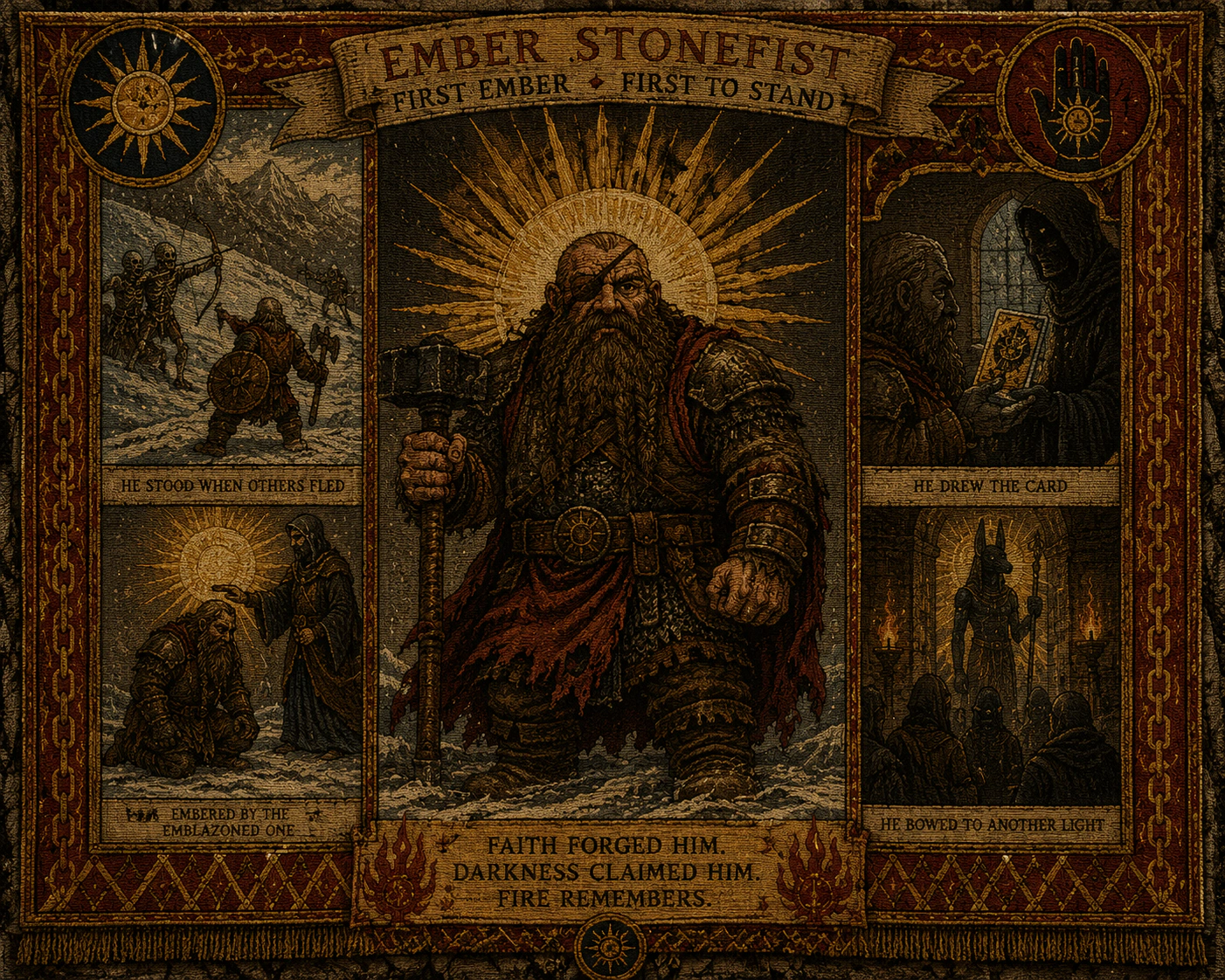
This tapestry depicts Thrain Stonefist not as a villain, but as a martyr who bore corruption so that others might recognise it. Though later condemned by orthodox Scorched Hand doctrine as The First Betrayer, the Ashbound believed Stonefist struggled against the darkness placed within him and delayed its spread for many years. His eventual fall is interpreted not as weakness, but sacrifice — a saintly warning that even the most faithful may be consumed if they carry the shadow alone for too long. The phrase stitched beneath him, “Faith forged him. Darkness claimed him. Fire remembers.”, became a central teaching amongst sects who viewed suffering and corruption as burdens to be endured rather than purged.
Selected Quotes
“Where the Emblazoned One brought flame, Stonefist carried the wood.” — Early Scorched Hand proverb
“He feared the dark so much he let something else live inside it.” — Attributed to Nux shortly before his execution
“The fire did not begin with Pyraxis. It began with trust.” — Anonymous post-Scorching commentary fragment