The Exigence Engine
Contents
Sumary
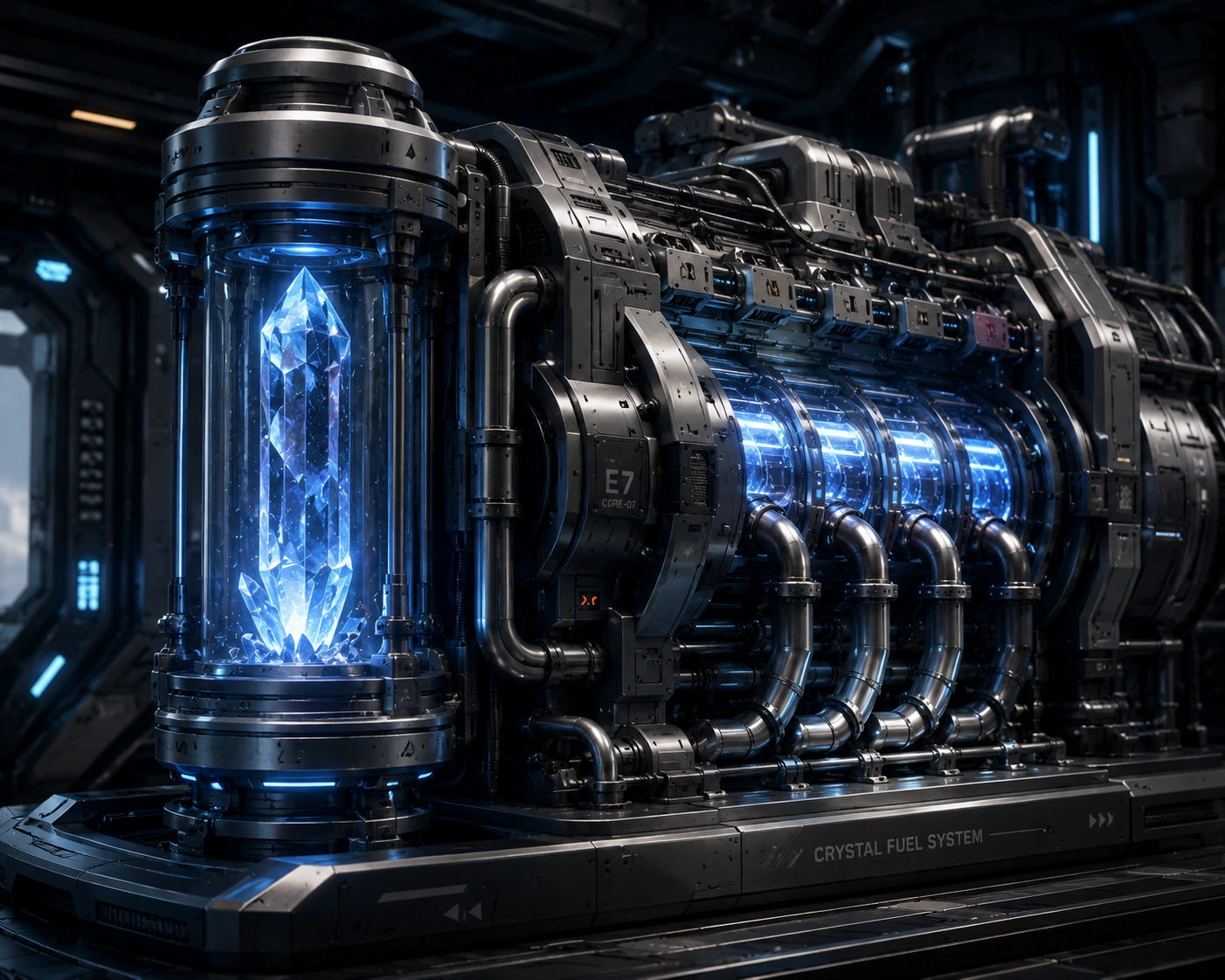
The Exigence Engine is an advanced power engine capable of producing immense quantities of energy by harnessing the volatile properties of Exigence Crystals, rare crystalline formations containing energy capable of altering the physical world around them. The engine was invented by the renowned artificer and engineer Hephae Emberline, who is credited with developing the first practical method of controlling an Exigence Crystal without causing catastrophic reality distortion.
The invention of the Exigence Engine is generally regarded as one of the most significant technological developments of the modern age. Its creation enabled a rapid expansion of mechanised industry, advanced transportation, and arcane technology, while simultaneously introducing unprecedented dangers associated with the manipulation of Exigence energy.
History
Discovery of Exigence Crystals
Exigence Crystals had been known to scholars and harvesters for centuries prior to the development of the engine. Unlike conventional magical crystals, Exigence Crystals do not merely store magical energy. They appear to contain a form of volatile potential, allowing the world immediately surrounding the crystal to behave according to circumstances that would otherwise be physically impossible.
Small crystals have been observed causing relatively minor effects, such as objects becoming temporarily weightless, metals changing shape without being heated, or flames burning without fuel. Larger specimens can produce considerably more dangerous phenomena, including spontaneous alterations to terrain, gravity, temperature, and even the apparent properties of matter.
For much of history, Exigence Crystals were considered too unstable to be useful as a practical energy source.
Development
Hephae Emberline became fascinated with Exigence Crystals during her early career as an artificer. Existing attempts to exploit the crystals generally involved extracting their energy directly, frequently resulting in uncontrolled manifestations of their reality-altering properties.
Emberline's breakthrough was the realisation that the crystal did not need to be drained. Instead, its volatile energy could be placed within a controlled cycle, allowing the engine to continuously extract useful energy while suppressing the crystal's tendency to distort its surroundings.
The resulting apparatus became known as the Exigence Engine.
The first successful prototype reportedly operated for only several minutes before melting much of Emberline's laboratory. Despite the destruction, the experiment demonstrated that sustained Exigence power was possible.
Emberline subsequently refined the design, eventually producing an engine capable of operating for extended periods.
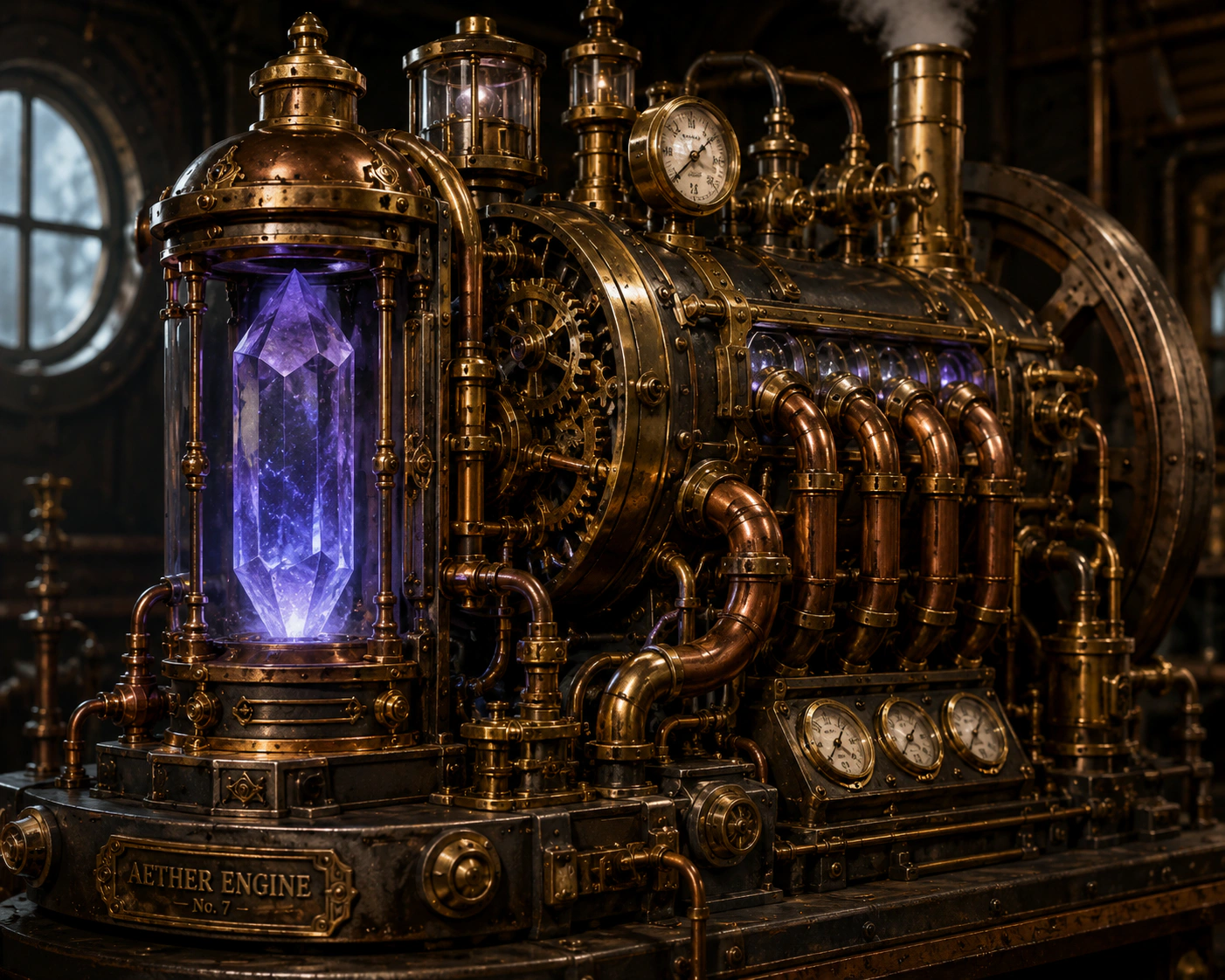
Early design of the Exigence Engine
Design and Operation
Design
The Exigence Engine consists of several major components:
Exigence Core – The central chamber containing one or more Exigence Crystals.
Containment Array – A series of mechanical and arcane structures designed to prevent the crystal's influence from escaping into the surrounding environment.
Regulation Rings – Rotating rings that regulate the crystal's energy output.
Conversion Chamber – Converts the crystal's volatile energy into a usable form of mechanical, magical, or electrical power.
Stabilisation Matrix – Prevents unwanted alterations to local reality.
Exhaust Manifold – Disperses residual energy produced during operation.
The exact configuration varies considerably between engines. Smaller versions can fit inside a large vehicle, while industrial models may occupy entire buildings.
Operation
An Exigence Crystal naturally attempts to impose its volatile energy upon its surroundings. The Exigence Engine instead forces this energy through a controlled cycle.
The crystal is placed within the containment array and stimulated by the regulation rings. As the crystal's energy builds, the containment system prevents the resulting distortions from propagating outward. The excess energy is then redirected into the conversion chamber.
The resulting power can be used to operate machinery, generate heat, propel vehicles, power weapons, or provide energy for increasingly sophisticated magical technology.
Unlike conventional engines, an Exigence Engine does not necessarily consume its crystal at a predictable rate. Under ideal conditions, a single crystal can remain operational for decades.
However, prolonged use gradually destabilises the crystal.
Reality Distortion
The primary danger associated with Exigence Engines is Exigence Distortion.
If the containment system fails, the crystal's stored potential may manifest unpredictably. The effects are highly variable and appear to depend upon the crystal itself.
Documented incidents include:
Sudden changes in gravity.
Buildings developing impossible architectural structures.
Objects changing material composition.
Localised time irregularities.
Spontaneous creation or disappearance of matter.
Areas where magical spells behave unpredictably.
Living organisms undergoing physical alterations.
Previously impossible objects temporarily becoming real.
Local terrain changing shape.
Severe containment failures can result in Exigence Events, during which an entire area may temporarily cease to obey established physical and magical laws.
For this reason, Exigence Engines are generally required to incorporate multiple independent containment systems.
Applications
The invention of the Exigence Engine transformed numerous industries.
Transportation
Exigence-powered locomotives, airships, ships, and automobiles are capable of achieving speeds previously considered impossible. Some experimental vehicles use controlled distortions of gravity to reduce their effective weight.
Industry
Factories equipped with Exigence Engines can operate machinery continuously without traditional fuel sources. This has allowed the development of enormous industrial complexes and highly automated manufacturing systems.
Energy
Cities increasingly use stationary Exigence Engines as power stations. These facilities provide energy for lighting, heating, communications, transportation, and magical infrastructure.
Military technology
Exigence technology has also been adapted for military applications. Engines can provide enormous amounts of power to weapons, defensive systems, and mechanised war machines.
The use of Exigence-powered weapons remains controversial due to the possibility that damage to their containment systems could produce unpredictable distortions.
Arcane research
Because Exigence energy appears capable of interacting with fundamental physical and magical laws, Exigence Engines have become valuable research instruments for physicists, artificers, and arcane scholars.
Legacy
The Exigence Engine ushered in what historians commonly refer to as the Exigence Age, characterised by rapid technological advancement and the widespread integration of magical and mechanical systems.
The technology has dramatically increased industrial productivity and enabled inventions previously regarded as impossible. At the same time, the existence of a practical method for manipulating reality-altering energy has created new political, scientific, and ethical challenges.
Debate continues among scholars regarding whether Exigence technology represents the next stage of civilisation or an inherently dangerous attempt to exploit forces that were never meant to be controlled.
Regardless of these disagreements, Emberline's invention fundamentally changed the relationship between magic, technology, and the physical world.